Last week, Ask Jeeves officially shut down after nearly 30 years. This news took me right back to the mid 90s, Burnley, Lancashire. Me and my bessie mate at the local library, excited to try this “internet” thing everyone was banging on about, because no one had it at home back then. The librarian fired up the dial-up, Ask Jeeves loaded, and we sat there giggling, trying to think of a question to ask.
We typed something in, glancing over our shoulder, hoping the librarian couldn’t read our question (I can NOT reveal what we asked here). And then… a list of links appeared.
We were confused. We had genuinely expected a direct answer. We left the library a bit disappointed in this whole “internet” thing, never finding out the answer to our question. Honestly, looking back, I’m surprised I went on to build a career out of it considering the let down of my first internet experience!
Now, 30 years later, I work in web development and SEO, and spend a fair chunk of my time figuring out how AI search engines decide who gets seen. The first time I opened ChatGPT a couple of years ago, I thought, FINALLY, this is how I expected it to work all those years ago back in the library: ask a question, get an answer!
What Was Ask Jeeves and Why It Was Different?
Ask Jeeves launched in 1996, founded by Garrett Gruener and David Warthen in Berkeley, California. The premise was genuinely ambitious for its time. Instead of forcing people to learn keyword tricks, you could ask a question in plain English, the way you’d ask another human being. A cartoon butler called Jeeves, named after P.G. Wodehouse’s famous gentleman’s gentleman, would politely fetch the answer.
That natural language search approach was the whole differentiator. Everyone else was running keyword-based crawlers. Jeeves was attempting conversational search a quarter of a century before “conversational AI” was even a phrase. However, the technology couldn’t quite live up to the promise, and someone else had a better idea.
Google rolled out its PageRank algorithm
In the late 90s, Google rolled out its PageRank algorithm. Instead of trying to understand your question, Google ranked websites based on how many other credible sites linked to them. The internet voted with its links. Google read the results.
The outcome was simple. Google’s results were just better. More relevant. More useful. People stopped asking Jeeves questions and started typing keywords.
Ask Jeeves never recovered. In 2005, media giant IAC bought it for $1.85 billion. In 2006, they retired the Jeeves character and rebranded to Ask.com, attempting to compete head-on as a traditional search engine. By 2010, IAC chairman Barry Diller publicly admitted the search side simply couldn’t compete with Google.
The Quiet Years (2010 to 2026)
This bit surprised me, because honestly, I’d assumed he disappeared years ago and it answers my own “wait, he was STILL going?!” reaction when I heard it was closing. For most of the last 15 years, Ask.com hasn’t really been a search engine in any meaningful sense. After 2010, IAC outsourced the actual search technology and pivoted Ask.com into a Q&A and content business. They bought up properties like Dictionary.com, Thesaurus.com, Reference.com and About.com. Ask.com itself became a quiet content site that most of us forgot existed.
The revenue, for years, came largely from two places. The infamous Ask Toolbar (bundled with software like Java, hijacking people’s browsers when they didn’t spot the pre-ticked checkbox) and Google ads served on the site. So, in a slightly painful twist, Ask.com effectively became a referral funnel into Google’s ad network for years.
The end of Ask.com
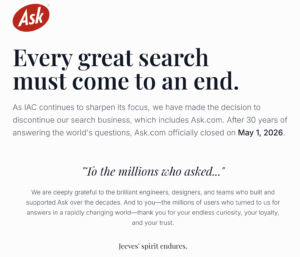
When IAC announced the closure on 1 May 2026, the official reason was “sharpening our focus.” The farewell note on the site signed off with: “Jeeves’ spirit endures.” And I agree. Every time someone asks ChatGPT, Gemini or Claude a question and gets a proper answer back, that’s the Jeeves dream finally working.
The Future of Search:From Search Engines to Answer Engines
The original Ask Jeeves promise, type a real question and get a real answer, is now the default way millions of people use the internet. We just call it AI search. The technology now exists to do what he was trying to do in 1996.
And this matters for your business, because how people search has fundamentally shifted. They don’t always go to Google any more. They ask AI. And those AI answers are pulled from a much smaller, more selective pool of sources than traditional search results.
That’s where AI visibility (or Generative Engine Optimisation, if you like the buzzword) comes in.
Strong SEO fundamentals are still the foundation. You still need a fast, well-structured, credible website with clear content and authoritative signals. But the prize has changed. Instead of just ranking on page one of Google, you’re now competing to be cited inside AI-generated answers.
What This Means for SEO and Website Owners
If your business isn’t visible in AI search results in 2026, that’s not a niche concern. It’s the future of how customers find you.
Ask Jeeves wasn’t a failure. He was a butler born about 25 years too soon. The vision was right. The technology just hadn’t caught up.
Now it has. And the businesses that adapt their websites and SEO to this new reality, where AI is doing the answering, will be the ones still showing up when potential customers ask their questions.
So pour one out for Jeeves. Then check whether your website is actually showing up where people are looking now.
If you’d like an honest review of how your site is performing in AI search and traditional SEO, get in touch. I’ll keep it in plain English. I’m sure Jeeves would approve.